








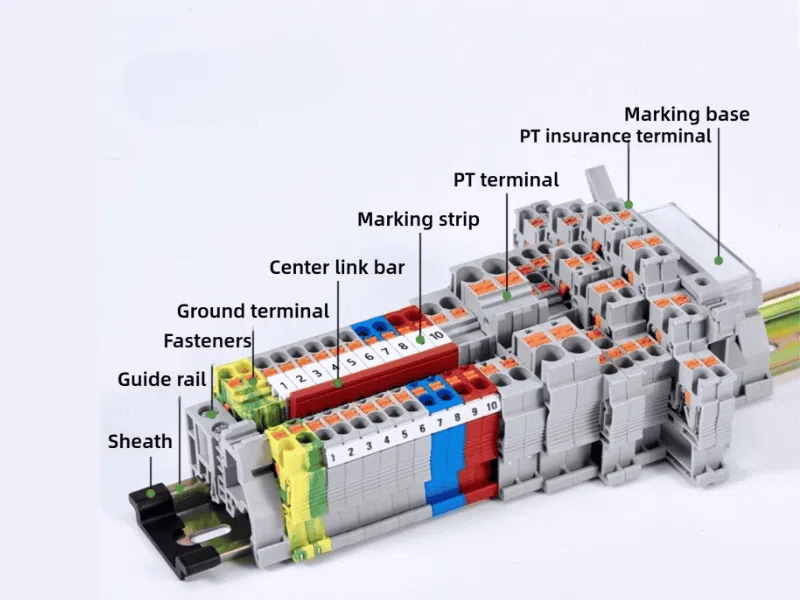
O DIN rail push-in terminal block has become the go-to solution for engineers designing efficient, compact, and maintenance-free control panels.
Unlike traditional screw or spring-cage types, the push-in design allows tool-free wiring, reliable contact under vibration, and easier modular organization.
This article explains how DIN rail push-in terminal blocks outperform other connection methods in wiring speed, safety, and long-term reliability — backed by data from IEC and UL-certified tests.
What Is DIN Rail Mounting and Why It Matters
A Calha DIN is a standardized metal track used to mount electrical components like terminal blocks, relays, or power supplies.
Its 35mm width standard (EN 60715) allows components from different brands to fit interchangeably — making system design modular and easy to expand.
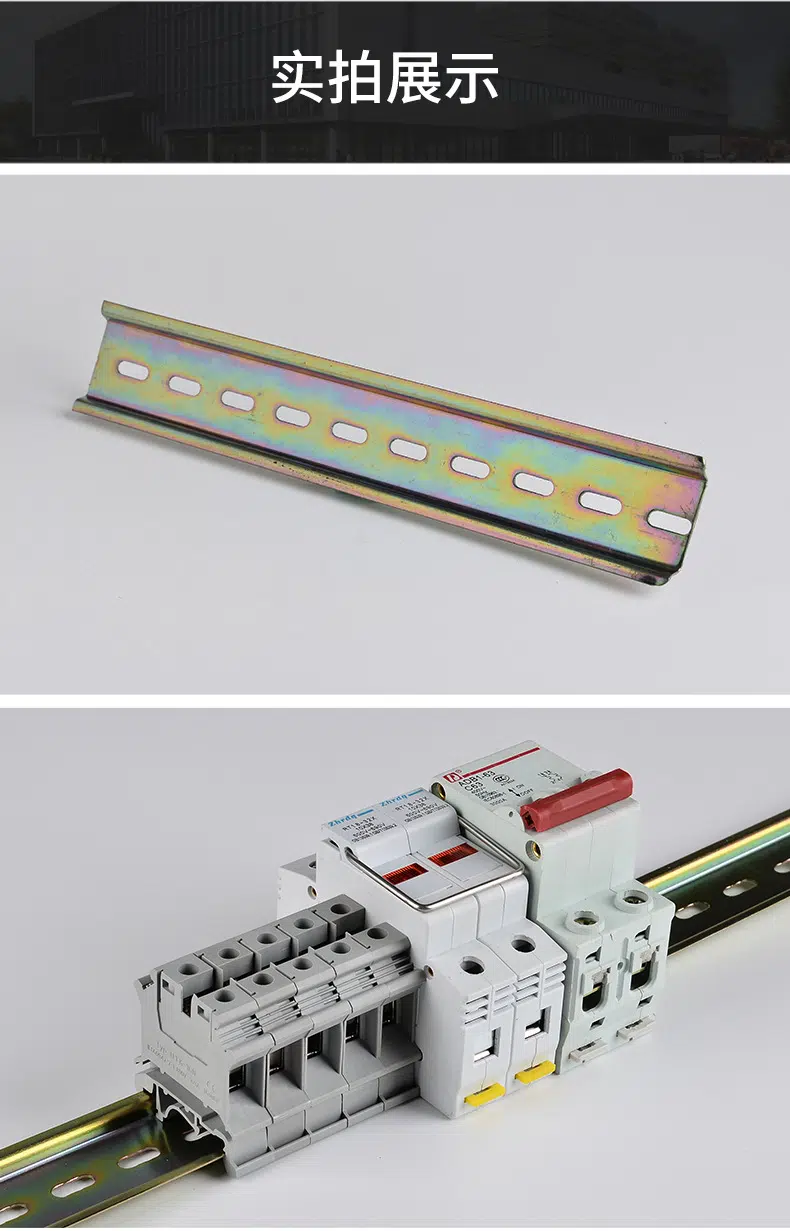
When paired with push-in terminals, the DIN rail offers three major benefits:
- Instalação rápida with direct snap-on mounting.
- Uniform layout for control cabinet organization.
- Compatibility across automation and power distribution systems.
For engineers building PLC control cabinets or machine interfaces, this combination ensures clean wiring, easier inspection, and consistent performance.
Related reading: What Is a Push-in Terminal Block and How It Works
Advantage 1 – Space and Organization in Control Panels
DIN rail push-in terminal blocks are designed to save both time and space in control cabinet layouts.
Their compact profiles and multi-level configurations reduce installation area by up to 40%, compared with traditional screw-type terminals.
Each terminal block snaps securely onto the DIN 35 rail, maintaining a clean and organized wiring path.
Color-coded housings, labeling slots, and modular jumpers simplify circuit identification — crucial for PLC control panels and automation wiring where every millimeter matters.
For instance, the AOSI PT2.5-3L multi-level terminal supports three vertically arranged connection levels in one compact unit,
allowing engineers to route signal, power, and ground wires within a single footprint.
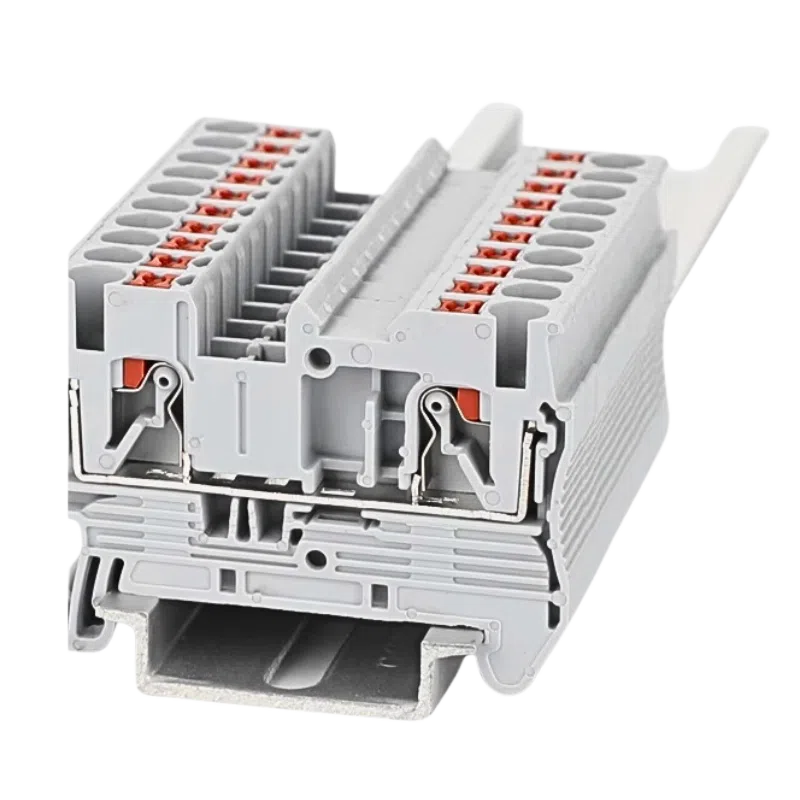
AOSI DIN Rail Push-in Terminal Series
- Engineered for industrial automation, AOSI’s DIN rail push-in terminals deliver fast wiring, vibration-proof reliability, and maintenance-free operation for control cabinets.
Advantage 2 – Faster Wiring and Assembly
One of the biggest advantages of DIN rail push-in terminals is their wiring speed.
Instead of manually tightening screws, engineers can simply insert pre-ferruled wires directly into the clamp —
a process up to 70% faster than conventional methods.
In large-scale production environments, this efficiency translates to measurable savings. A single technician can complete hundreds of connections per hour, shortening assembly cycles and enabling faster delivery for control cabinets and machinery panels.
Manufacturers such as Contacto Phoenix e Weidmüller have validated that push-in connection technology reduces wiring time by 60–70% while ensuring uniform torque-free contact pressure.
Advantage 3 – Reliable Performance
Factories and automation systems constantly face mechanical vibration and thermal cycling.
Over time, screw terminals can loosen slightly — leading to arcing, signal loss, or even overheating.
Em contrapartida, DIN rail push-in terminal blocks maintain constant contact pressure through a stainless-steel spring clamp.
This design prevents loosening under vibration and compensates for temperature expansion,
ensuring safe and stable conductivity for years.
These connectors comply with IEC 60068-2-6 (vibration test) and IEC 60512-11-7 (thermal endurance),
proving superior long-term reliability in industrial automation, renewable energy, and power distribution applications.
Learn how push-in terminals compare to screw types in our detailed guide:Push-in vs Screw Terminal Blocks: Which Is Best for Your Panel?
Advantage 4 – Maintenance-Free Wiring Solution
Once installed, push-in terminals require zero re-tightening — ever.
Unlike screw-based systems that demand periodic torque verification,
push-in designs maintain a consistent spring force on the conductor for the product’s lifetime.
This maintenance-free design significantly reduces downtime and inspection costs in automation plants.
According to Phoenix Contact’s Control Cabinet Study (2023),
plants using push-in wiring experienced zero torque-related failures after five years of continuous service.
For integrators and OEMs, this means higher productivity and fewer wiring-related callouts during maintenance cycles.
Advantage 5 – Flexible Wiring and Quick Testing
DIN rail push-in terminals aren’t just faster to wire — they also simplify circuit expansion and system testing.
Each terminal is built with plug-in jumpers e test points, allowing engineers to measure voltage or continuity
without disconnecting any conductors.
During PLC commissioning or maintenance, technicians can easily insert test probes into the built-in ports to monitor signals in real time.
This makes troubleshooting and functional testing both faster and safer — essential for modern automation control systems.
Because the terminal blocks are modular, additional circuits or relay lines can be added without rewiring the entire DIN rail.
It’s a design built for flexibility — supporting quick adjustments, expansions, and diagnostics in any industrial environment.
FAQs of DIN Rail Push-in Terminal Blocks
A1: DIN rail push-in terminal blocks combine tool-free wiring, compact size, and high vibration resistance. Compared with screw-type terminals, they reduce wiring time by up to 70%, save DIN rail space, and offer maintenance-free operation for PLC and automation systems.
A2: Absolutely. Both use the same DIN 35 mm mounting standard, making it easy to upgrade existing systems. Many engineers transition gradually — combining both types during maintenance cycles for flexibility.
Learn how they compare in our detailed guide: Push-in vs Screw Terminal Blocks: Which Is Best for Your Panel?
A3: Push-in terminals use stainless-steel spring clamps that maintain constant contact pressure. They withstand vibration, shock, and thermal expansion far better than screw types — proven by IEC 60068-2-6 testing.
A4: Yes. High-quality DIN rail push-in terminal blocks (such as AOSI’s series) are engineered for harsh industrial environments. They typically feature flame-retardant housing (UL94 V-0 rated), corrosion-resistant tin-plated copper conductors, and compliance with IEC 60068-2-6 (vibration) and IEC 60512-11-7 (thermal endurance) standards. This allows them to withstand extreme temperatures (-40°C to +105°C), mechanical vibration, dust, and humidity — making them suitable for applications like renewable energy (solar/wind), transportation (railway signaling), and heavy industrial automation where harsh conditions are common.
Conclusão
DIN rail push-in terminal blocks represent a new standard in control cabinet wiring — combining speed, compact design, and industrial-grade reliability.
Their tool-free, vibration-resistant design eliminates torque maintenance and improves long-term system uptime.
Upgrading from traditional screw types to push-in technology is not just faster — it’s a strategic improvement for the entire wiring process.
👉 Explore the AOSI DIN Rail Push-in Terminal Series to discover models designed for PLC, automation, and energy systems — engineered for the future of industrial connection.