








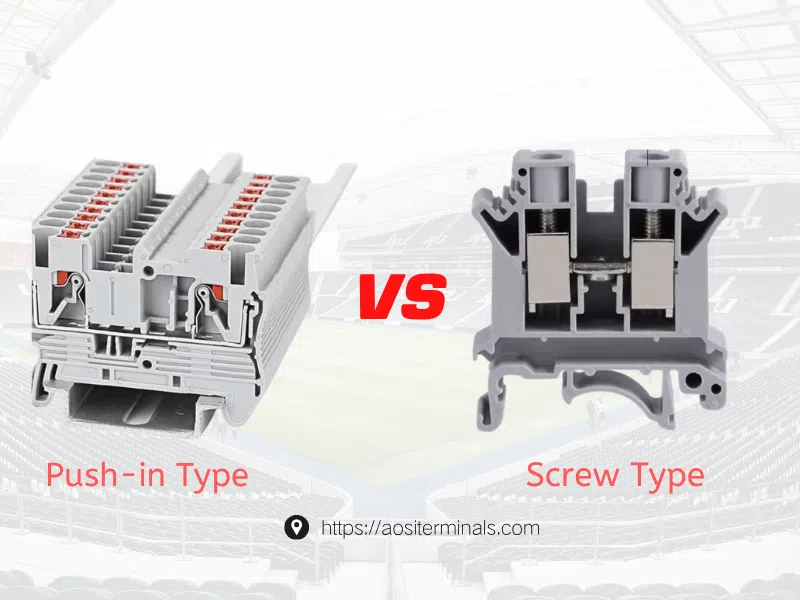
Selecting the right terminal block for your electrical panel is crucial for ensuring safe, efficient, and maintainable wiring. Both push-in and screw terminal blocks serve the purpose of connecting wires securely, but their design and performance characteristics differ, affecting installation speed, reliability, maintenance, and cost. This article provides a detailed comparison of push in vs screw terminal block technologies, helping engineers and panel designers make informed decisions for modern automation systems.
How Each Terminal Block Connects Wires
Let’s start with the basics — how do these two connection types actually hold your wires in place?
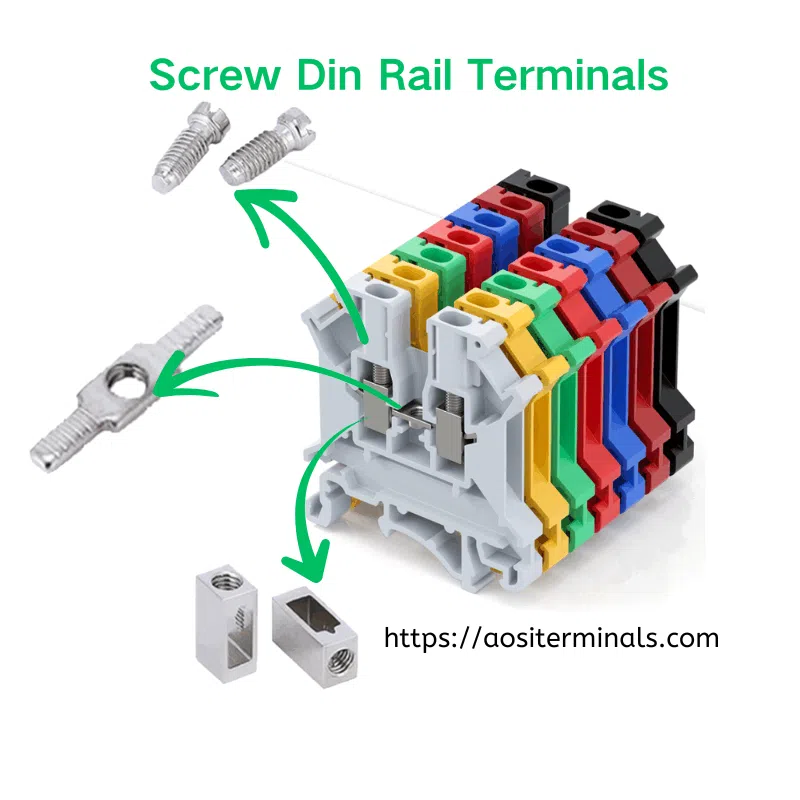
Screw terminals rely on a simple principle: tighten the screw, and the wire stays put. The stripped conductor is pressed between a clamp and a conductive bar. It’s reliable, but it demands perfect torque — too loose and you get arcing; too tight and you risk wire damage.
Push-in terminals, however, skip the screwdriver. Just insert the wire, and a stainless spring automatically grips it with consistent pressure. The result? A secure, gas-tight contact that resists vibration and saves your wrists.
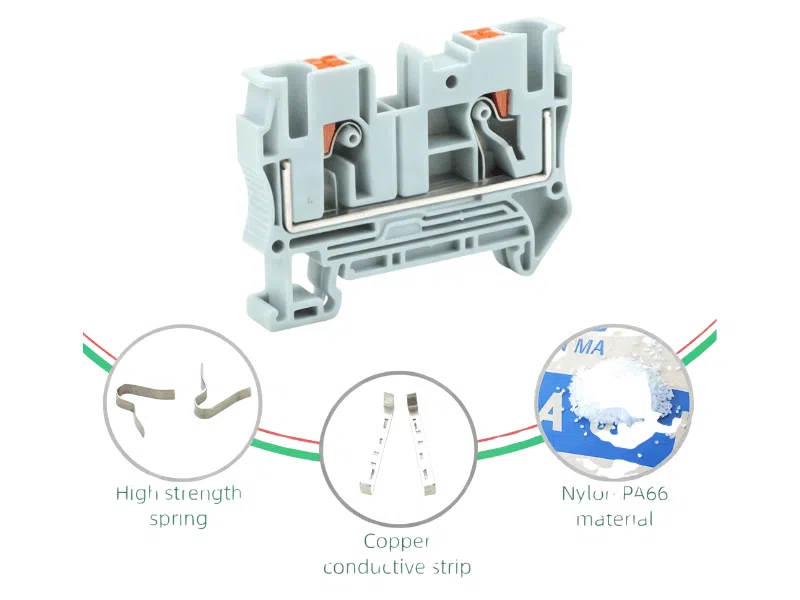
No screwdriver or torque tool is required, making this a true tool-free connection system ideal for fast, repeatable wiring.
🔗 Related reading: Push-in Connection Technology in Terminal Blocks
Which One Wires Faster and Lasts Longer?
Here’s where things get interesting: wiring speed and maintenance.
If you’ve ever wired a full control panel, you know time equals cost. Push-in terminals can reduce wiring time by up to 70%, thanks to their tool-free design. No screws to tighten, no torque to verify — just push and go.
Screw terminals, on the other hand, still work great but require regular torque checks. Over time, vibration or temperature changes can loosen them, meaning more maintenance hours for your team.
So if your project involves hundreds of connections, push-in saves not just time — but long-term fatigue, too.
Reliability and Safety
- Contact Stability Under Vibration
Screw terminals can loosen over time due to vibration, thermal expansion, or material creep. Push-in terminals, on the other hand, maintain constant clamping force through their stainless-steel spring — making them ideal for industrial automation, transportation, and power systems. - Electrical Conductivity
Both types provide excellent conductivity if installed correctly. However, push-in models maintain more consistent contact resistance because the spring applies uniform pressure regardless of conductor variation. - Certification and Standards
Both connection types are tested according to UL 1059 and IEC 60947-7-1. Push-in terminals also undergo IEC 60068-2-6 vibration testing to ensure mechanical stability. - Safety and Human Error Reduction
With screw terminals, improper torque or missing ferrules can lead to arcing or wire slippage. Push-in technology eliminates these risks with a repeatable insertion process, ensuring safe, standardized wiring across large production lines.
Is Push-in Worth It in the Long Run?
Let’s talk money — not just the unit cost, but the real total cost of ownership.
Sure, screw terminals are cheaper up front. But push-in types pay you back fast through labor savings, fewer tools, and zero re-tightening.
According to a Phoenix Contact study, factories switching to push-in terminals reduced assembly time by 60–70%, cutting wiring labor by days per batch.
Add in the maintenance-free design, and the ROI becomes obvious within the first production cycle.
In short — yes, push-in is absolutely worth it if your project values time, safety, and scalability.
When to Choose Push-in or Screw Type
Choosing the right terminal type depends on application, environment, and budget priorities:
| Scenario | Recommended Type | Reason |
| High-volume automation wiring | 푸시인 | Faster installation, consistent results |
| Compact PLC control cabinets | Push-in/ | Space-saving, no maintenance |
| Field wiring with mixed conductor types | 나사 | Flexible for stranded or irregular wires |
| 진동이 심한 환경 | 푸시인 | Spring maintains constant clamping force |
| Budget-sensitive projects | 나사 | Lower initial cost, simple installation |
In most modern automation and control systems, push-in terminals are now considered the preferred choice for professional panel building due to their combination of speed, reliability, and safety.
🔗 See also: Push-in Terminal Block Series – AOSI Product Overview
FAQs – Push-in vs Screw Terminal Blocks
A1: No. The spring mechanism keeps consistent pressure on the conductor, preventing loosening. In contrast, screw terminals may require periodic torque verification.
A2: Yes. High-performance push-in models like the AOSI PT4 and PT6 series handle up to 41A, suitable for power distribution and control circuits.
결론
The debate between push-in vs screw terminal blocks isn’t about right or wrong — it’s about efficiency, application, and future-proof design.
Push-in terminals offer faster wiring, consistent contact force, and lower maintenance costs, making them ideal for automation, PLC, and machine control systems.
Screw terminals remain useful for general-purpose wiring and mixed conductor types, but for OEMs and control panel manufacturers prioritizing efficiency, push-in connection technology clearly leads the way.
Explore the AOSI Push-in Terminal Block Series to experience certified quality and performance that meets the demands of modern electrical engineering.